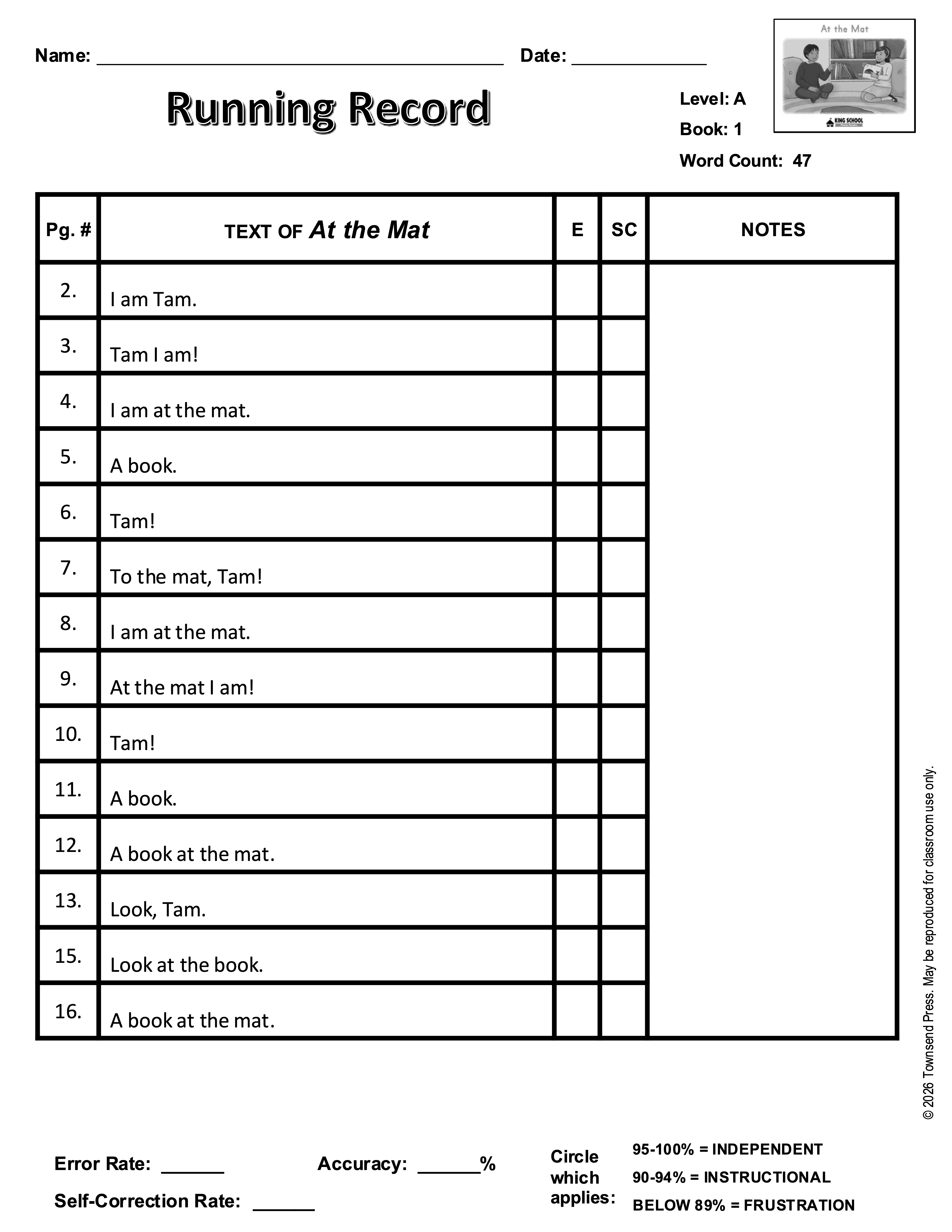
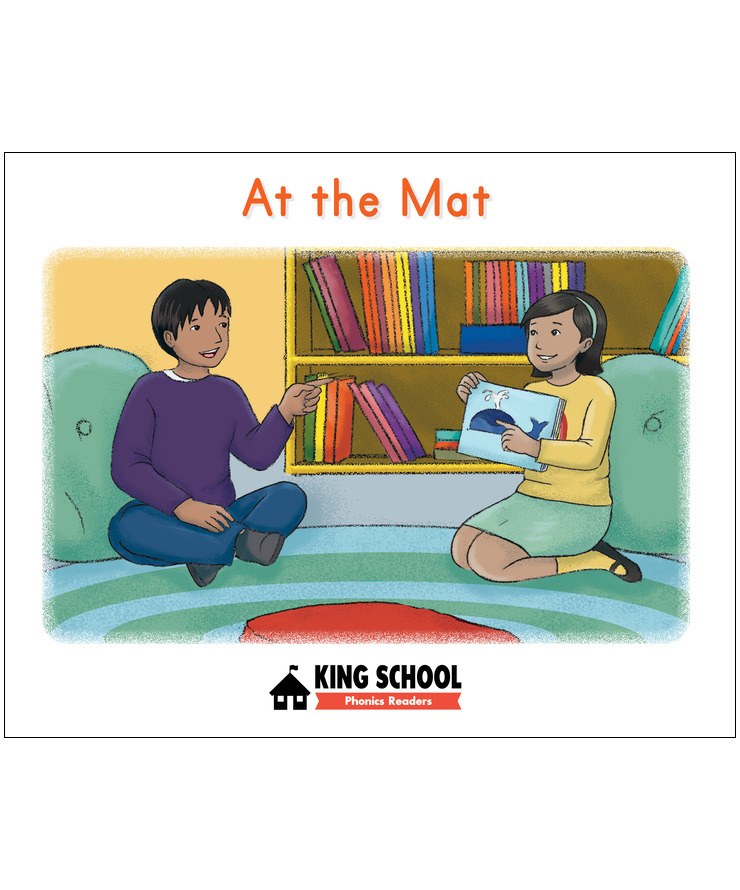
At the Mat
Overview
More information
• Effective phonics instruction. Mastering phonics concepts is crucial to the development of confident and proficient readers. The decodable texts in this collection are grounded in the evidence-based research on reading acquisition, developing students’ phonological awareness through an explicit and systematic approach (a.k.a. the Science of Reading). This pedagogy nurtures a deep understanding of the relationship between sounds and letters, empowering students on their journey to become strong, independent readers.
• Careful and deliberate sequencing. Our thoughtfully designed pedagogy ensures that students progress through sequential phonics skills, mastering basic concepts before advancing to more complex ones. Each text is at least 80% decodable, reinforcing the phonics skills that readers have already learned. As readers gain proficiency, their confidence flourishes, paving the way for a lifelong love of reading.
The King School Phonics Readers are also informed by the Dolch and Fry high-frequency word lists, which identify the most commonly encountered words in reading and writing. The strategic inclusion of high-frequency words in our decodable texts ensures that readers are introduced to essential words in a way that supports optimal fluency and comprehension.
• Structured practice. The King School Phonics Readers provide structured practice across 32 texts in Level A and 32 texts in Level B (aligned with grade K and 1, respectively, but usable by older students as well). The Scope and Sequence chart tracks the progression of skills throughout this decodable series, delineating the phonics concepts and words introduced in each book. This chart can be used to facilitate instructional planning and ensure a coherent trajectory for student learning.
• Clear layout and design. Clear font and page layout maximizes readability and skill acquisition for nascent readers. This reader-friendly design and evidence-based pedagogy foster an upward spiral of achievement, improving students’ skills while boosting their confidence and desire to read. And the compact length—16 pages in all—provides readers with a sense of accomplishment and pleasure in reading a book from start to finish.
• Engaging stories that cultivate personal skills. While developing their decoding skills, students will also enjoy the lively stories they encounter in this series. Each book has been crafted to appeal to children’s interests, concerns, and experiences: enjoying a snow day, cheering up a sad friend, going on a school field trip, having to do chores, making a new friend, and many more. The books have been carefully developed—in positive and developmentally appropriate ways—to incorporate a variety of personal skills, including identifying and dealing with emotions, relating to others in positive ways, being a good community member, and so on. Like the phonics pedagogy, the personal skills lessons are scaffolded and progress from simpler to more sophisticated topics.
• Exceptionally appealing characters. Every book is about the King School Kids, a group of spirited students in Mrs. Hall’s class at the King School. Mirroring today’s classrooms, the King School Kids represent various backgrounds and abilities. Students will have no trouble finding characters with whom they can identify and whose adventures they are eager to follow.
King School Phonics Readers: Science of Reading Alignment
The King School Phonics Readers (KSPR) are innovative decodable books designed to foster early literacy skills. This series serves as a tool for introducing phonics systematically, with each book carefully crafted to teach letter-sound correspondences in an explicit and sequential manner. The 64 books are organized into Levels A and B, allowing for a natural progression of difficulty that supports diverse learning needs, independent of traditional grade levels. Grounded in the “Science of Reading,” our decodable books provide young learners with the foundational skills they need to become confident readers, building a strong foundation for lifelong reading success.
This alignment with the research that supports the Science of Reading not only enhances students' letter-sound correspondence, decoding, and reading fluency skills but also supports comprehension, providing a well-rounded foundation for emerging readers.
Emphasis on Phonemic Awareness
Each KSPR book is designed to help young readers recognize and manipulate sounds within words. Students are introduced to various phonemes in isolation and in context, which enhances their sound recognition abilities. In addition to the books themselves, the Teacher’s Guide provides student reproducibles for each book that feature activities designed to reinforce the skills introduced in the text. These exercises encourage students to blend individual phonemes to form words, helping them develop the ability to hear and manipulate sounds in a sequential way.
Systematic Phonics Instruction
The KSPR Scope and Sequence is carefully designed with the Science of Reading in mind, incorporating targeted phonics instruction into each book. Each book is 80% decodable, reinforcing phonics skills that readers have already learned. Starting with consonant and short vowel sounds in the early Level A books, students begin to grasp the fundamental relationship between letters and sounds, enabling them to decode CVC words. As they progress through Level A and into Level B, readers expand their phonics knowledge to include consonant blends, long vowels, vowel teams, digraphs, and diphthongs. The Teacher’s Guide offers a wealth of lessons and hands-on activities to reinforce and deepen these skills through interactive instruction and practice.
Vocabulary Development
Readers' vocabulary development is enhanced through the use of high-frequency words and "story words." By incorporating high-frequency words from the Dolch and Fry lists, the books provide repeated exposure to these essential words in meaningful contexts, allowing readers to internalize them effectively. These words are carefully and systematically integrated throughout the series, ensuring gradual mastery. Additionally, “story words” introduce new vocabulary in a controlled and manageable way, supporting vocabulary growth without overwhelming readers. Over time, this consistent exposure broadens their vocabulary, laying a strong foundation for more advanced reading and communication skills. The accompanying Teacher’s Guide offers strategies for engaging instruction, helping educators introduce high-frequency and story words in fun, interactive ways.
Fluency
Through the systematic reinforcement of phonics patterns, children can begin to read more smoothly and with greater accuracy. These texts also reduce cognitive load by providing familiar words and simple sentence structures, allowing young readers to focus on comprehension and expression. Gradually increasing in difficulty, the decodable books motivate independent readers and provide frequent practice with high-frequency words, ultimately helping children build confidence and fluency as they progress.
Comprehension Focus & Cultivation of Personal Skills
In addition to the carefully crafted decodable text, the illustrations in the KSPR series provide rich visual context, helping young readers connect more deeply with the story and enhancing their comprehension. The engaging artwork offers clues that encourage readers to make predictions and infer meaning, further strengthening their understanding of the text.
The books also incorporate personal learning skills, such as emotional awareness, empathy, and self-regulation, which are reinforced through relatable characters and real-life situations. The series is designed not only to support decoding and comprehension but also to create a positive and enjoyable reading experience, motivating students to keep reading and develop a lifelong love of books.
This decodable book series aligns with the Science of Reading by providing a structured, phonics-based approach that supports the development of essential decoding skills through systematic instruction. By focusing on high-frequency words, phonetic patterns, and repetition, the KSPR series helps young readers build fluency and comprehension, the foundation for long-term reading success.
Orton-Gillingham alignment provided upon request. Email cs@townsendpress.com.
The King School Phonics Readers: Scope and Sequence
Level A
| Book # | Title | Phonics Skill | HFW | Word Count |
|---|---|---|---|---|
| 1 | At the Mat | short a, Mm, Tt | a, I, the | 47 |
| 2 | Pam | Pp, Ss (as /s/ and /z/) | is, it | 51 |
| 3 | It Is | short i | and, as, at | 51 |
| 4 | The Nap | Ff, Nn | can, to | 53 |
| 5 | Miss Tan | -ff, -ss, -tt (double consonant endings) | look, my | 49 |
| 6 | Pop! | short o | go, we | 53 |
| 7 | Cass the Cat | hard c (Cc says /k/ when followed by a, o, or u) | like, this | 54 |
| 8 | Toss and Hit | Hh, inflectional ending -s (no spelling changes) | am, up | 49 |
| 9 | Bob the Rat | Bb, Rr | are, for | 49 |
| 10 | Pip the Pup | short u | she, that | 48 |
| 11 | Dad and I | Dd | he, said | 58 |
| 12 | I Bet I Can | short e | me, with | 54 |
| 13 | A Wet Kiss | Kk, Ww | by, has, his | 57 |
| 14 | Pals | Ll, -ll (double consonant ending) | be, but, had | 64 |
| 15 | A Plan | initial blends (using only letters taught up to this point) | book, of, you | 67 |
| 16 | Gus Is Glum | Gg | him, no | 55 |
| 17 | Jess and Jeff | Jj, Yy (Initial -y acts as a consonant at the beginning of a word but is a vowel elsewhere.) | all, here, will | 79 |
| 18 | I Lent a Hand | final consonant blends (with letters taught to date: -st, -nd, -nt, -nk, -mp, -ft) | her, was | 67 |
| 19 | The Quest | Qq (initial /kw/) | from, or | 77 |
| 20 | Rex the Fox | Xx (final /ks/) | do, have | 70 |
| 21 | The Van | Vv, Zz | one, so | 65 |
| 22 | Jack and I | consonant digraph ck | did, when | 64 |
| 23 | The Chest | consonant digraph ch | how, what | 68 |
| 24 | The Bath | consonant digraph th | must, were | 67 |
| 25 | A Big Red Fish | consonant digraph sh | out, their | 71 |
| 26 | WHACK! WHAM! | consonant digraph wh | play, they | 69 |
| 27 | The Song | consonant digraph ng | then, went | 82 |
| 28 | Test the Brakes | long a spelled a_e | there, your | 78 |
| 29 | Fun with a Hose | long o spelled o, o_e | want, which | 97 |
| 30 | A Safe Hike | long i spelled i_e | each, words | 82 |
| 31 | Jack Is Cute | long u spelled u_e | an, use | 85 |
| 32 | We Like These | long e spelled e, e_e | about, who | 82 |
Level B
| Book # | Title | Phonics Skill | HFW | Word Count |
|---|---|---|---|---|
| 1 | The Chess Set | ch, -tch | some, them | 87 |
| 2 | I Can Ice Skate | soft c | many, these | 83 |
| 3 | On a Stage | soft g | good, than | 114 |
| 4 | Picking Up Shells | inflectional ending -ing (no spelling changes) | into, other | 117 |
| 5 | Jack Jumped | inflectional ending -ed (no spelling changes) | come, say | 99 |
| 6 | Hike on a Ridge | consonant trigraph -dge | more, would | 163 |
| 7 | Plant Stamps | CCVCC, initial and final blends | see, two | 123 |
| 8 | The Splint | spl-, spr- (three-letter blends) | little, new | 108 |
| 9 | A Hut from Scraps | scr-, str- (three-letter blends) | after, could | 120 |
| 10 | A Big Problem | words with two closed syllables | over, write | 131 |
| 11 | Not That Way | long a spelled ay (vowel digraph) | ask, our | 144 |
| 12 | The Late Train | long a spelled ai (vowel digraph) | down, put, puts | 187 |
| 13 | Free Time | long e spelled ee (vowel digraph) | now, too | 165 |
| 14 | Read as a Team | long e spelled ea (vowel digraph) | first, number | 139 |
| 15 | Dream and Float | long o spelled oa (vowel digraph) | been, saw | 166 |
| 16 | Go with the Flow | long o spelled ow (vowel digraph) | again, know | 172 |
| 17 | My Pal Joe | long o spelled oe (vowel digraph) | give, gives, people | 189 |
| 18 | The Pie | long i spelled ie (vowel digraph) | think, very | 159 |
| 19 | Night Light | long i spelled igh (vowel trigraph) | any, where | 138 |
| 20 | I Feel Shy | long i spelled y | live, water | 183 |
| 21 | A Game of Clues | long u spelled ue (vowel digraph) | find, open | 160 |
| 22 | Snow Suits | long u spelled ui (vowel digraph) | call, called, why | 126 |
| 23 | My Sister’s Dinner | r-controlled vowel er | make, makes, thing | 154 |
| 24 | The Storm | r-controlled vowel or | old, years | 139 |
| 25 | Twirl in My Skirt | r-controlled vowel ir | take, way | 161 |
| 26 | At the Farm | r-controlled vowel ar | only, work, works | 181 |
| 27 | Skip My Turn | r-controlled vowel ur | help, helps, walk | 150 |
| 28 | Lunch with Roy | diphthongs oi, oy | day, great | 151 |
| 29 | Bad Mood | diphthongs ew, oo | part, through | 141 |
| 30 | The Book Nook | diphthong oo | both, every | 153 |
| 31 | How to Sit Still | diphthong ow | most, place | 195 |
| 32 | We Found Peace | diphthong ou | found, sound, sounds | 163 |
The King School Phonics Readers: Personal Skills Focus
Level A
| Books 1–5 | Sense of community: positive and safe environments, sense of belonging |
| Books 6–10 | Self-awareness: identifying emotions, strengths, and challenges |
| Books 11–15 | Self-management: regulating emotions, impulse control, goal-setting |
| Books 16–20 | Awareness: empathy, welcoming others |
| Books 21–27 | Relationship skills: listening skills, cooperation, sharing, resolving disagreements |
| Books 28–32 | Responsible decision-making: choices and consequences, problem-solving, safety and responsibility |
Level B
| Books 1–3 | Self-awareness: naming emotions and personal strengths |
| Books 4–6 | Self-management: managing emotions, patience, self-control |
| Books 7–9 | Awareness: empathy, respecting others, community and belonging |
| Books 10–12 | Relationship skills: making and keeping friends, conflict resolution |
| Books 13–14 | Responsible decision-making: understanding choices and consequences, making decisions as a group |
| Books 15–17 | Emotion-regulating techniques: deep breathing, counting, expressing feelings through words |
| Books 18–20 | Perspective-taking: understanding others’ points of view |
| Books 21–24 | Cooperation and teamwork: team activities that require working together |
| Books 25–28 | Appreciation of others: celebrating people, learning about various cultures, qualities, and abilities |
| Books 29–32 | Mindfulness: strategies to keep a calm body |
Teacher’s Guide
The King School Phonics Readers feature a comprehensive Teacher’s Guide which includes everything you need to help students connect with the stories and acquire the phonics skills they need to become skilled readers. The Teacher’s Guide provides a Lesson Plan for every book in the series and includes the following:
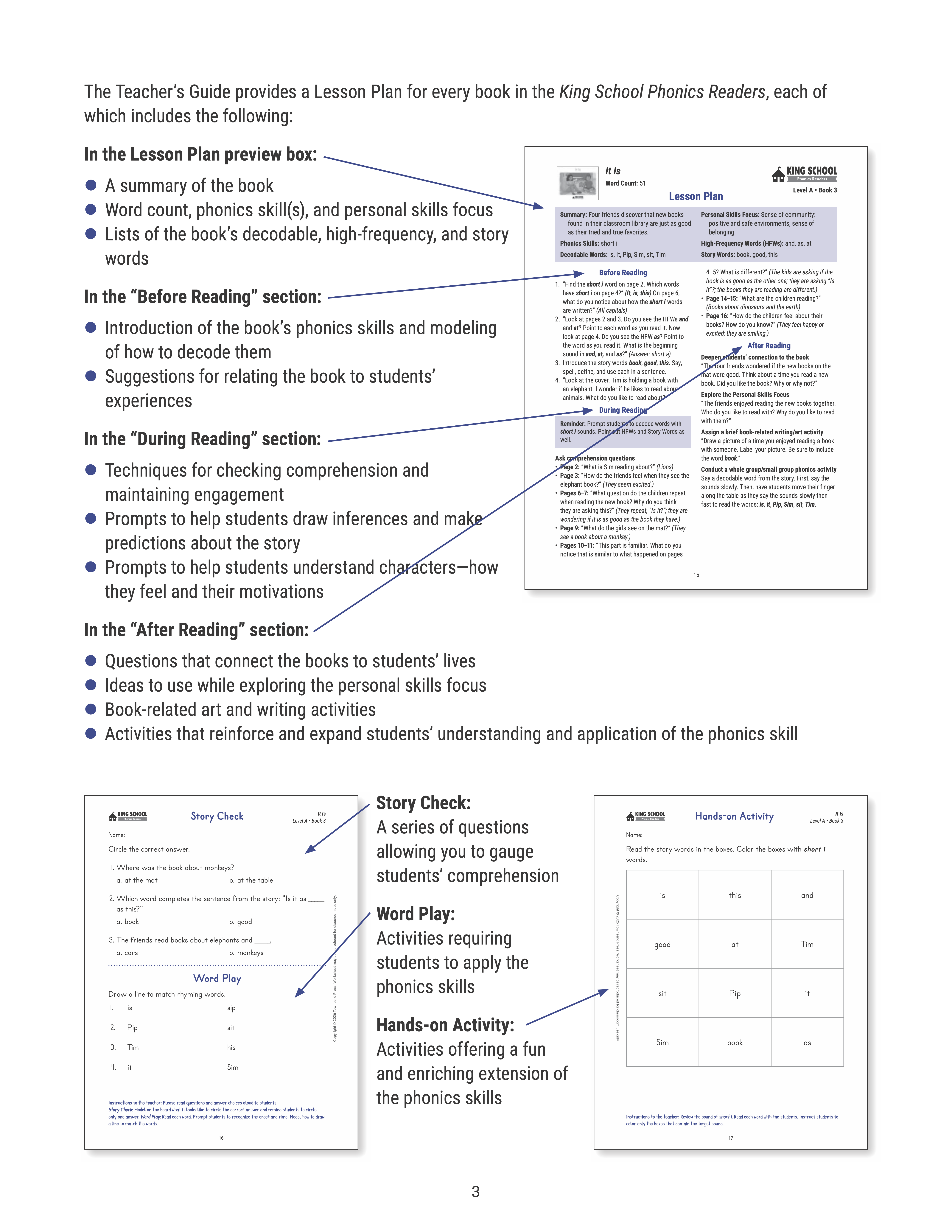
The printed version of the King School Phonics Readers Teacher’s Guide is available for purchase; a downloadable PDF is available for free to teachers with an account in our Learning Center.
Running Records
Customized to every book in the series, these one-page, downloadable Running Records help teachers assess students’ reading mastery of each story. The printable PDFs are available with a free Instructor account in the Townsend Press Learning Center.